



Why tracking accuracy matters in a privacy-first world
Since the rollout of GDPR and the rise of browser-level tracking restrictions (like ITP on Safari or Enhanced Tracking Protection on Firefox), traditional cookie-based conversion tracking has lost reliability. For marketers, this means fewer visible conversions, weaker match rates, and distorted attribution models.
Enhanced Conversions in Google Ads were designed to address this exact issue. By sending hashed first-party data (like emails or phone numbers) when users complete a conversion, advertisers can preserve measurement accuracy while staying compliant with data privacy standards.
What are Enhanced Conversions in Google Ads and how do they work?
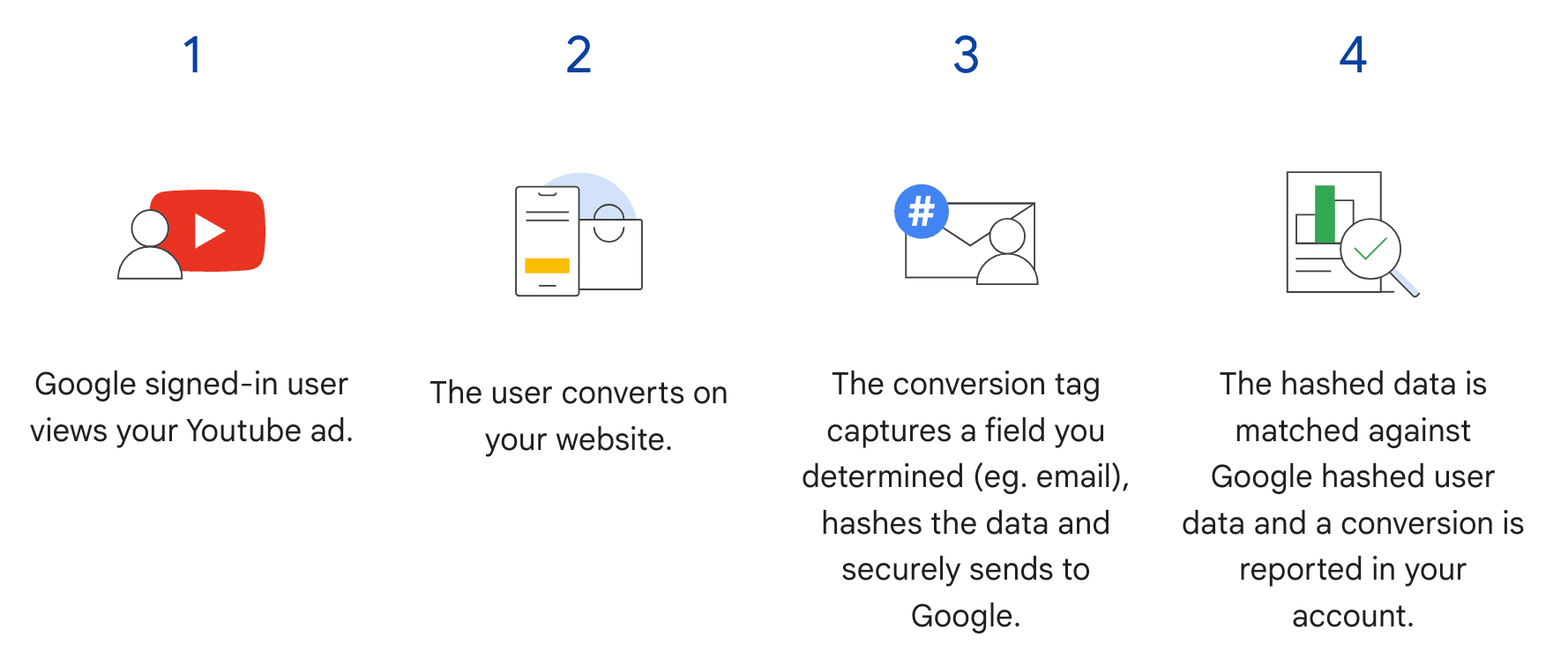
Enhanced Conversions in Google Ads are an advanced tracking feature that improves your ability to measure online and offline conversions accurately. When a user completes a conversion action on your website or through a lead form, Google can use first-party data (like email or phone) to match it with signed-in Google accounts. This data is hashed and anonymized before being sent, respecting privacy standards while restoring lost attribution.
This is especially useful in an era of increasing cookie restrictions and browser limitations. By supplementing standard conversion tags, Enhanced Conversions help advertisers maintain visibility on performance, even when cookies fail.
How to install Enhanced Conversions for Web in Google Ads
To implement Enhanced Conversions for Web:
- Use Google Tag Manager (GTM): Ensure you have access to GTM and configure the Google Ads Conversion Tracking tag. Activate Enhanced Conversions in the tag settings.
- Enable in Google Ads UI: Go to your conversion action, edit the settings, and toggle on Enhanced Conversions.
- Map first-party data: Identify and send user data such as email, phone, or name from your site’s form fields.
- Hashing is automatic: Google handles the hashing process (SHA-256) for all data sent.
- Test the implementation using Google’s Tag Assistant and debug tools.
Correct setup helps ensure you're capturing more accurate conversion signals from logged-in users.
How to set up enhanced conversions with the Google tag using the google tag
Enhanced conversions improve the accuracy of your conversion tracking by securely sending hashed first-party data, like email addresses, directly from your website to Google. This data is then matched with signed-in users to better attribute conversions to your ads.
To set it up with the Google tag, follow these steps:
- Access your Google Ads account and navigate to Goals > Conversions > Settings.
- Enable enhanced conversions and confirm compliance with Google’s customer data policies.
- Under “Choose a method,” select Google tag as your tagging approach.
- Decide how to capture user data:
Automatic detection (low effort, less control)CSS selectors or JavaScript variables (manual but precise)Custom code snippet (ideal for consistent, reliable data)
After saving your setup, test your implementation using Chrome Developer Tools and Google’s Diagnostics report. Results typically appear in your conversion reports after 30 days.
This setup gives marketing teams better attribution insights, which can lead to smarter bidding strategies and more effective budget allocation, especially important for businesses relying heavily on paid traffic.
What is hashing and why it matters for Enhanced Conversions
Hashing is a process that converts readable data (like an email address) into a fixed-length string of characters. Google uses SHA-256 hashing before sending any user information.
This matters because:
- It secures personal data during transmission.
- It aligns with data privacy standards like GDPR.
- It enables matching without exposing the raw user info.
Understanding hashing reassures stakeholders that Enhanced Conversions are privacy-conscious and compliant.
Why you should implement Enhanced Conversions in Google Ads today
With increasing browser restrictions, iOS limitations, and third-party cookie deprecation, traditional conversion tracking is losing reliability.
By implementing Enhanced Conversions, you:
- Improve match rates and attribution accuracy
- Recover lost conversions that cookies can’t track
- Strengthen your bidding models and Smart Bidding
- Future-proof your analytics in a privacy-first landscape
You will also unlock conversion modeling with more conversion data for google amchine learning
Here are google articles